Stellar Populations of NGC 6822 with JWST
I completed my PhD at the University of Edinburgh in 2025. With my supervisor Olivia Jones, we worked on the first resolved stellar populations observed by JWST, with specific focus on the evolved dust producing stars. I developed starbug2, a PSF photometry set of tools for detecting faint and deeply dust embedded point sources in complex and crowded environments.
Read my thesis (coming soon).
Lay summary
When a star like our Sun gets to the end of its life, it will expand so large as to engulf the Earth. This red giant becomes a thousand times brighter and very unstable. We call it an "Asymptotic Giant Branch" (AGB) star. These dying stars are important because they produce a lot of dust, and as the saying goes, "everything is made of star dust". AGB stars, therefore, play a crucial role in the production of natal materials from which all planets and stars are formed.
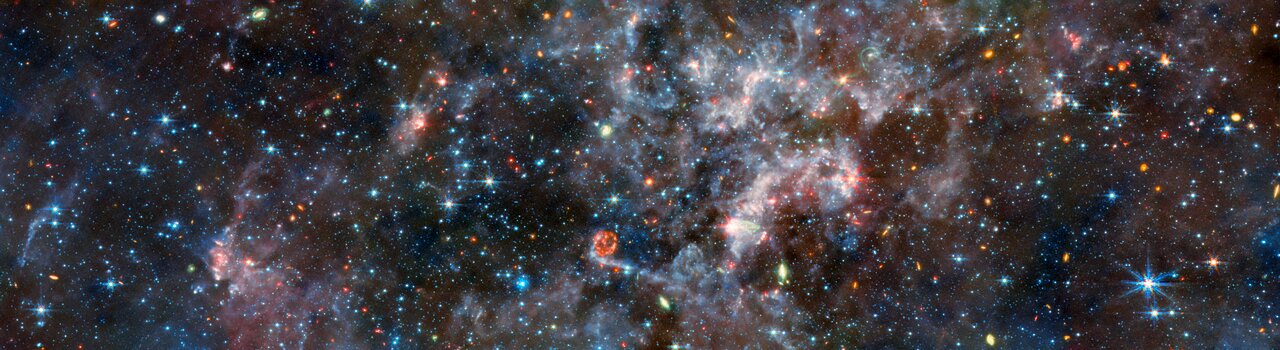
NGC 6822 Mid-IR view | ESA JWST Pitcure of the Month 07/2023
With the new space telescope, JWST, we can observe these AGB stars in more detail than ever before. By studying them in a diverse range of galaxies, we can begin to build a picture of the origin and continued recycling of dust in the Universe. One such galaxy is NGC 6822. Although it is one of our closest galactic neighbours (~1.5 million light years away), it has a similar composition to galaxies in the more distant Universe.
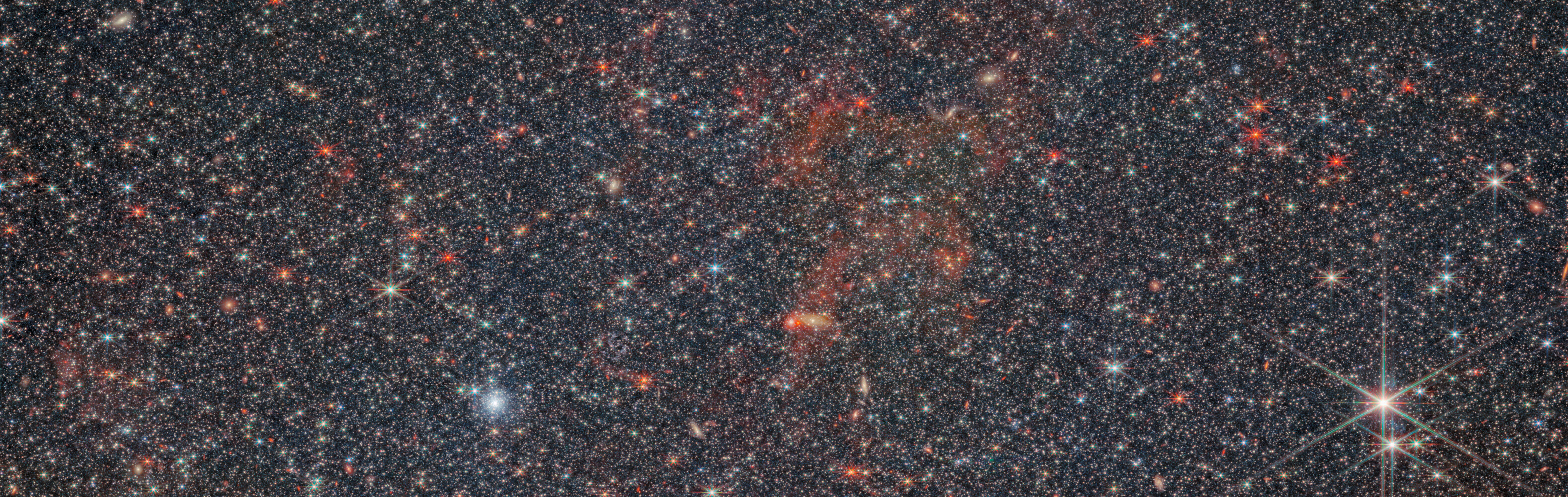
NGC 6822 Near-IR view | ESA JWST Pitcure of the Month 09/2023
In my thesis, I develop the tools to detect nearly a million stars in infrared JWST images of the central region of NGC 6822. I identify a wide range of "species", locating a small subset that are the AGB stars. By matching the shapes of their spectra to a library of theoretical models, I measure properties such as temperature, luminosity, chemical composition and the rate at which they produce dust. I demonstrate that the majority of the dust originates from a small number of particularly extreme individuals, and estimate the total quantity produced throughout the entire galaxy. By isolating the primary chemistry of the stars, I find that NGC 6822 exhibits a far higher proportion of oxygen-rich dust than expected. Finally, I develop a system of measuring AGB dust production rate from a set of observable properties, allowing for this research to be conducted at a greater scale in the future.